Real Estate, Translated
Here to help you read between the headlines.
The real Land Man + his impact on Colorado’s future
If you’ve been to a Nuggets or Avalanche game, or if you’ve watched your favorite band perform at Ball Arena, you have felt the footprint of Stan Kroenke in Colorado. But here’s something you might not realize…
Following a massive New Mexico land deal on January 13, he now owns approximately 2.7 million acres of land across the United States, which makes him the largest private landowner in the country.
Just to put that into perspective…
That’s roughly 500K acres larger than Yellowstone National Park.
That’s 2x the size of Delaware.
That’s 6x the size of Rocky Mountain National Park.
That’s 25x the size of the city of Denver.
That’s over 2M football fields.
That’s 18.8M double residential lots in Denver Proper. (A true “Denver double” lot is 6,250 SF.)
WOWWW.
So the real estate question becomes: what does this mean for Colorado? Pull up a chair and let’s talk about it!
Full Disclaimer: I nerd out about stuff like this so I’m about to go deep and for those of you who don’t want to read on, here’s the TLDR: I think it’s wildly fascinating and ultimately, a great sign for our city.
Ok, let’s dive in! First, in today’s world, owning a sports team isn’t just about championships. It’s about control of the surrounding real estate. Kroenke owns Kroenke Sports & Entertainment, which controls the Nuggets, the Avalanche, the Rapids, the Mammoth, the LA Rams, and the Arsenal men’s and women’s soccer teams, in addition to venues like Ball Arena, DICK’S Sporting Goods Park, Paramount Theater and Elitch Gardens, and Altitude Sports & Entertainment.
And because I know you’ve heard whispers about the massive redevelopment project planned around Ball Arena known as River Mile, you already know that this isn’t about sports. As much as I love them, this isn’t their moment. This is about urban redevelopment at scale.
Did you know that as of June 2025, the 62-acre River Mile project surrounding Ball Arena is now owned exclusively by Kroenke? He bought out Revesco Properties’ interest in the investment, making him the sole owner in a development that is going to change Denver’s landscape. When one entity controls both the arena and the land around it, they don’t just influence games - they influence housing, zoning, retail + office space, hospitality, new development, public transit integration, riverfront activations, and so much more.
In addition to Kroenke’s Denver real estate holdings, his most recent land acquisition has put him on the map on a national level… and increased his leverage accordingly. The more land you control, the more levers you have to pull: preserve it, develop it, lease it, trade it, sell it, or hold it. More dirt = more possible moves. And in real estate, having options is power.
For comparison’s sake, let’s look at McDonald's. I may or may not have indulged in a late-night quarter pounder once or twice… I won’t tell if you don’t.
Anyway, most people think McDonald’s is in the burger business.
It’s not. It’s in the real estate business.
McDonald’s owns (or controls through long-term leases) the land under the majority of its locations, where franchisees pay rent. The quarter pounders may be the attraction, but the land is the long-term play, and the golden arches are just anchors for the real estate, which typically appreciates over time.
Let’s translate that back to Denver.
The games & concerts are the attraction, Ball Arena is the anchor, and the surrounding land is the long-term play.
Just like McDonald’s uses their restaurants to drive predictable traffic to their real estate, sports franchises do the exact same thing - and I’d venture that it’s even more predictable because of their respective seasons. So when one ownership group controls both the entertainment assets and the surrounding development opportunity, they’re poised to shape a city and its future.
Now, let’s examine the fact that his land portfolio leans heavily western. His largest land acquisitions started with ranches, and ranches aren’t impulse purchases. They are rooted in generational wealth strategy, with confidence in long-term land value and often times, an interest in influence or control over natural resources.
Colorado sits in a unique position because we’re a desirable lifestyle state with limited buildable land, strict water constraints, and increasing development pressure. When a single owner holds vast acreage across the West, it creates leverage and influence over how land and natural resources are preserved, managed, or potentially activated in the future.
Here’s another thing most people don’t think about: large-scale development is simply easier when fewer decision-makers are involved. In any big project, multiple decision-makers slow progress down. Multiple landowners = multiple agendas. When one ownership group controls a large footprint like River Mile, projects can move faster, more cohesively, and more strategically. It becomes less democratic, but I would argue that it’s more efficient if managed properly.
So again, what exactly does this signal for Colorado real estate?
That it’s a strong long-term investment.
Why? Because big bets send signals. Let’s say you’re in Vegas. When a high roller repeatedly bets big on a blackjack table, you naturally lean in - without even thinking about it. So when an ultra-high-net-worth individual continues doubling down on Western land specifically, it reinforces something we’re already seeing on the ground. It’s not a short-term play; it’s a long-term asset.
They’re essentially saying: “This land will matter more in 30 years, not less.” That level of confidence has a massive ripple effect, and it makes you think in decades versus election cycles. This matters because Rome wasn’t built in a day and cities aren’t shaped overnight. They are built and shaped by who holds the land and how long they plan to hold it. And what this tells me is that not only is Kroenke betting on the West, he’s betting on Denver, land scarcity, and long-term value.
Personally, I’d much rather have big-picture thinkers shaping our skyline than short-term flippers chasing quarterly returns. This is exactly the kind of confidence and hope that I’m leaning into right now, and if you know someone who is looking to make a wise investment in Colorado, I’d love to help them find it!
Call or text me directly any time: 970-331-1352
Why people are rethinking Denver - and why I’m not
According to headlines, the data shows that thousands fewer people are moving to Denver, with one study claiming that net migration to Metro Denver is down by nearly 70% from 2015 to 2025, while the statewide drop is 52.5%.
And look, I get it. Housing costs are higher, the cost of living is higher, and maintaining the level of growth we saw during the pandemic isn’t sustainable.
The secret is out and Denver may not be the hidden gem it once was, but as someone who just hit her 17-year Colorado anniversary on January 3, I can’t help but think that maybe they’re focusing on the wrong things.
Colorado isn’t perfect, and I won’t pretend that it is, but in my opinion, it’s still one of the best lifestyle states in the country. So instead of arguing with the data, I want to translate it by adding my own two cents.
Here are the top 10 things I wish I had known before I moved here and the top 10 things I love about living here. And I would love to know what yours are!
10 Things I Wish I Knew Before Moving to Colorado
1. However Much Chapstick You Think You Need… Multiply it by 10
I can accidentally forget my phone at home and survive the evening. Under no circumstances, and I mean none, can I forget my emotional support chapstick. It is glued to me at all times. Same goes for hand lotion. Buy both in bulk and thank me later.
2. The “New Kid on the Block” Energy is Real
Despite the recent numbers, we still have a huge transplant population, which means people are used to meeting new people and there aren’t as many closed-off cliques that you sometimes find in small towns where everyone knows everyone. New neighbors, new kids at school, new coworkers… most people are open, kind and welcoming in a way that surprises a lot of people. It’s incredibly easy to meet new people and make friends here if you’re willing to put yourself out there.
3. No One Can Drive Here (Including Me), But It’s Not Because of the Snow.
To be fair, I hate driving anywhere, but I do think the melting pot of transplants might make it a bit worse here. Too much time on I-25 or I-70 will make you wonder how most people passed the driving test when they can’t figure out merging lanes to save their lives. But on the positive side, I still think it’s easier to drive in snow than rain. Take it slow and you’ll be just fine.
4. The First Snow of the Year is Usually Big and Messy
Usually early November. Sometimes earlier. Sometimes later. Sometimes the snow sticks. Sometimes it’s gone the next day. The first snow of the season is always an adventure and everyone acts like we’ve never seen it before. The last snow of the season typically falls around late April or early May, which is why we follow the golden rule: Blow out your sprinkler lines by Halloween and don’t plant anything until after Mother’s Day.
5. Green Chile is a Whole Thing
I didn’t even know what it was before I moved here and you don’t have to love it, but natives take it seriously and you will form opinions eventually. La Loma gets my vote, even though it pushes the boundaries of my very limited spice threshold. (Yes I know, I have the tastebuds of a three-year-old.)
6. People Love to Complain about the Food and Dating Scenes
I think it’s somewhat of a mindset problem.
Is this the very best place in the entire world to eat and date? No. But are there restaurants that will make your mouth water and amazing people who will steal your heart? Absolutely.
If you believe it’s terrible, that’s what you’ll experience, but if you stay curious and optimistic, you’ll find your places and your people. I know I have, in both categories.
7. The Sushi Landscape is Shockingly Competitive
Yes, really. Yes, I know we’re landlocked in the middle of the country. But the bar is high and Denver is quietly an excellent sushi city if you know where to go. Always happy to share my favorite recs!
8. If You’re Bored Here, That’s on You
This truly is the land of hobbies. Skiing. Hiking. Cycling. Pilates. Pickleball. Ceramics. Fly fishing. Book clubs. Trivia nights. Side quests of all kinds. It is extremely normal - and socially encouraged - to have things you’re into and personally, I love that.
9. Everything Dries Almost Instantly
Pool towels. Bath towels. Handwashed dishes. Hang-dry clothes. Coming from Florida, this feels like a small miracle that I don’t take for granted.
10. You Will Check the Weather More Than Instagram
And if you’re anything like me, it’ll eventually become one of your favorite hobbies. It’s not unusual to experience all four seasons in a day, so always keep layers handy and if you don’t like the weather, just give it a few minutes and it will change.
10 Things I Still Love About Colorado
300 days of sunshine all year long.
An active lifestyle feels genuine without being performative - unless you’re in Boulder. (Just kidding… kind of.)
Every Denver neighborhood has its own VERY unique personality.
We have easy access to nature without giving up urban conveniences.
Dogs. Are. Everywhere. (This is probably my #1 if I’m being honest.)
People value balance over burnout.
It may not be perfect, but we get all four seasons in one form or another.
You’re allowed - and encouraged - to evolve here. No one will punish you for changing your mind, your career, your partner, or your newest hobby / obsession. Grow, evolve, reinvent yourself if you need to - we’re here for it and here for you.
Life here feels very full without feeling overwhelming.
DIA might be a disaster, but landing in Denver always feels like coming home.
Final Thought
I don’t care what the migration data says. Colorado isn’t for everyone, but when it fits, it really fits.
If you know someone thinking about moving here, or someone already here who’s considering a move within the state, I’d love to help in any way I can. Whether that’s answering questions, sharing insight on neighborhoods, or helping them land somewhere that matches their lifestyle, where you live should support the life you want.
Call or text me directly any time: 970-331-1352
When mortgage rates flirt with 5.99% … and what it actually means
Is it true that interest rates dropped to 5.99%?! Yep… for a minute! Exciting? Yes! Permanent? Nope.
Wait, what?! Let me explain.
Over the past year, mortgage rates have been moving in the right direction overall, but it’s not as cut and dry as the headlines might lead you to believe. For starters, interest rates change by the hour and can change drastically overnight, so are they going to sit perfectly still at 5.99%?
You would have a better chance of getting a three-year-old to sit perfectly still through a two-hour play.
In fact, both of them have already moved. But, that’s NORMAL!
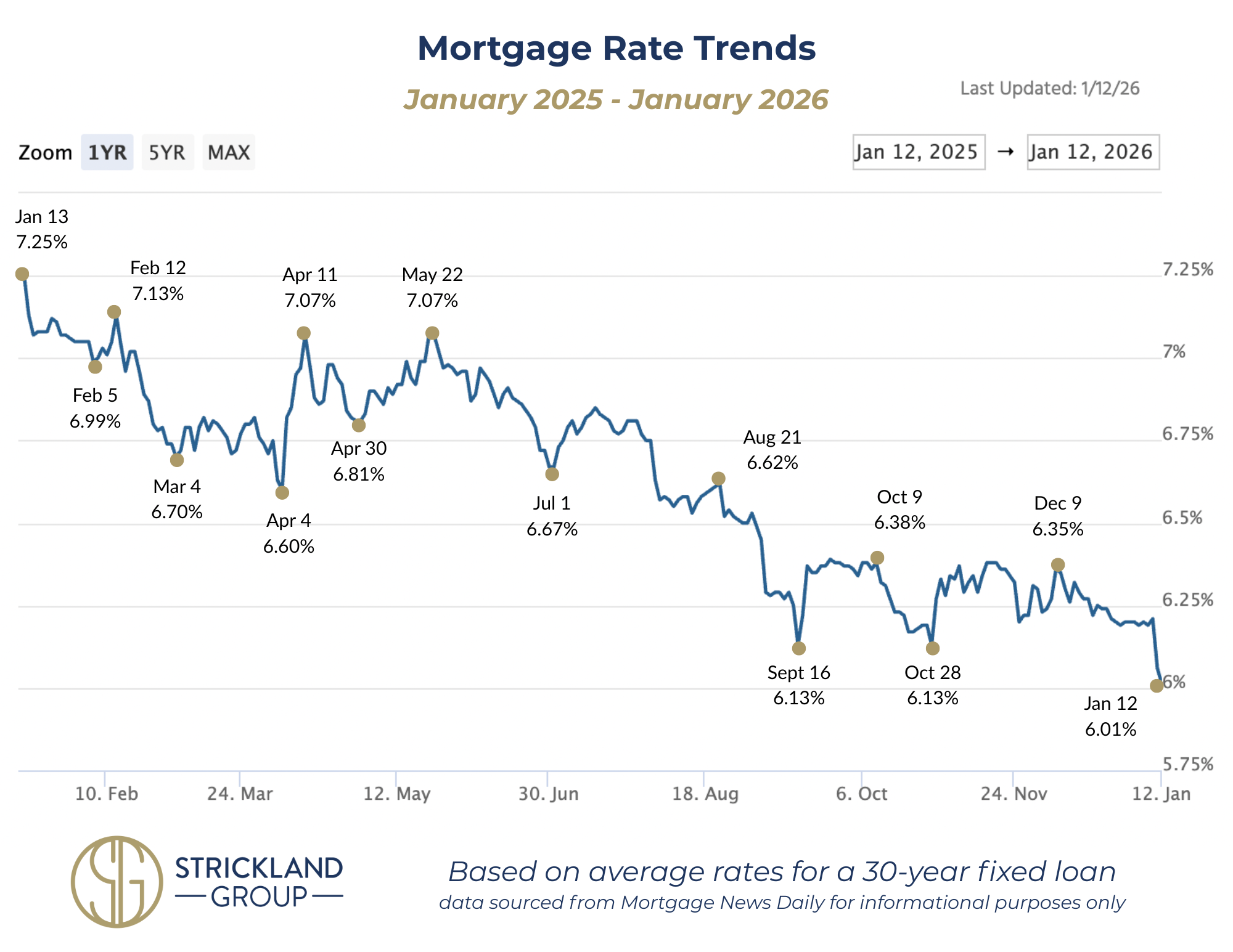
This is the first time we’ve seen rates drop below 6% in three years - if only for a moment - and it does feel promising as we look towards the year ahead. Looking at the year behind us on the chart below, you can see the overall downward trajectory of interest rates throughout 2025, as well as the fluctuations up and down.
In this particular instance, it’s important to understand why we saw that sudden drop to 5.99% over the weekend. Mortgage rates are tied to mortgage-backed securities (essentially, bundles of home loans) that investors buy and sell. When the administration instructed representatives to purchase $200 billion worth of these mortgage bonds, it dramatically increased bond demand overnight. Higher demand for mortgage bonds = lower interest rates for buyers. HOWEVER, there is not a set plan in place yet as far as when these actual purchases will take place.
While this move caused a temporary boost, it did not cause a permanent reset of the rate environment. So no, we’re not going to see a resurgence of 2 - 3% pandemic rates. Rates will continue to fluctuate due to many factors, including but not limited to global news, unemployment numbers, inflation, the bond market, tariffs, etc.
You might be thinking, "Ok, so then how do I time the market?"
When you’re buying, it’s hard to perfectly time the market because you have no control over whether the right house AND the right interest rate will surface at the same time. If you work with a strong agent + lender team, your agent can help you understand the leverage you have in crafting your offer, and the lender can help you understand the current rate conditions, as well as the best time to lock your interest rate so that you are comfortable with your monthly payment. Then, if rates drop further later on, your lender can help you refinance and capture the lowest possible rate.
Now moving on to the big picture, if interest rates continue to decrease during 2026, what happens??
What do lower interest rates mean for Buyers? When we see rates drop to a steady low number, the first buyers in the market win because it usually takes a little time for demand to go up, which is what causes home prices to go up. If you're thinking about buying in 2026, I would consider getting your ducks in a row sooner rather than later in case the right opportunity arises. Remember that interest rates and home prices will ALWAYS have an inverse relationship: lower interest rates = higher home prices; higher interest rates = lower home prices.
What do lower interest rates mean for Sellers? If rates remain steady and gradually decreasing, we will likely see buyers that have been on the fence for the last few years start to re-enter the market. That means if you have been waiting for the market to improve in order to sell, this could be your year. If your goal is to sell, I wouldn't wait for a big drop to start preparing, or else you could end up missing the boat. There's no need to rush into the market right this minute, but having an open-ended conversation to understand what to expect will save you from scrambling when the time is right.
What does all of this mean for YOU? I have no idea, but I would love the opportunity to talk through it with you! No pressure to buy, no pressure to sell, no pressure to refinance... simply up-to-date information that you can trust so that you can make the right decisions for you and your family.
Call or text me directly any time: 970-331-1352